

In rural Tajikistan, a significant portion of households and farms maintain livestock, with each typically owning 1-2 cows, 3-4 sheep, and 5-10 hens. Additionally, individual and family dehkan farms commonly possess 5-10 cows, while numerous small and medium-sized livestock farms are scattered throughout the country. Consequently, nearly every household and dehkan farm has access to animal manure, which holds crucial importance in preserving soil fertility when utilized as organic fertilizers and compost.
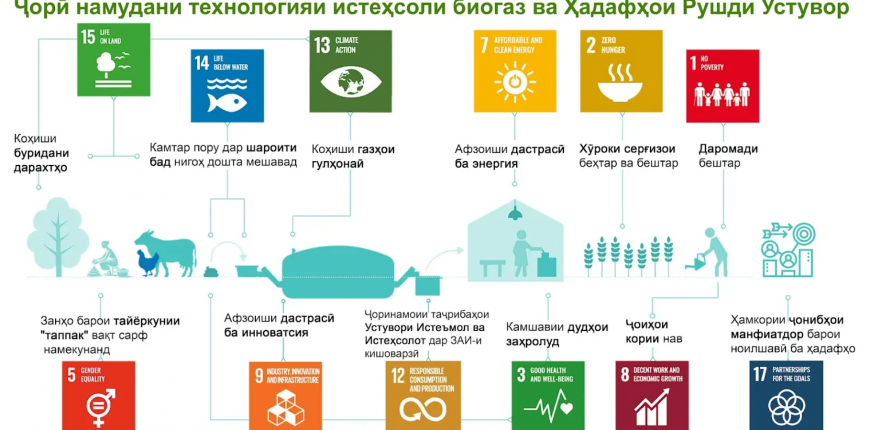
However, a prevalent practice in Tajikistan involves drying the animal manure to prepare “cow-cakes”, for later use as a source of energy for cooking and heating homes. This custom has roots in the frequent electricity cuts experienced in rural areas throughout autumn, winter, and spring, coupled with the high cost of liquefied gas. It should be noted here that the responsibility for drying animal manure and preparing “cow-cakes” typically falls on young women as part of their traditional gender role. The combustion of dung emits smoke and particulate matter, contributing to indoor and outdoor air pollution impacting women’s and children’s health, and using manure as fuel instead of transforming it into organic fertilizer prevents soil enrichment, crucial for Tajikistan’s food security. Introduction of bioreactor technology to produce biogas out of cattle dung and the biofertilizer as a by-product of using this technology is vital as an alternative sustainable energy, soil health and rural women’s wellbeing.
In order to address these issues, UNDP has launched a pilot initiative called Empowering Rural Women through access to renewable energy via biodigesters, which will introduce a biodigester technology to produce biogas out of cattle dung to use for cooking fuel in selected rural households.
| Use case | Climate Smart Agriculture, Sustainable Farming, Technology & Innovation, Waste Reduction |
| Funding | United Nations Development Programme |
| Donor | UNDP |
| Focus Area | To introduce a biodigester technology to produce biogas out of cattle dung to use for cooking fuel in selected rural households |
| Objectives | — The rural population in the pilot areas has acquired skills and awareness of the biodigester technology and the selected households have begun utilizing biogas and biofertilizers to meet their needs — Policy advocacy for biogas energy with policy makers and stakeholders |
| Start Date | 15-07-2024 |
| End Date | 31-05-2025 |
| Duration | 10,5 months |
| Coverage | — Varzob, Hisor, Rudaki, Vahdat, Shahrinav, Rasht, Tojikobod, Sangvor and Lakhsh in DRS — Norak, Hamadoni, Sh. Shohin, Vakhsh, A. Jomi, Farkhor, Kulob, Jayhun, Vose and Danghara in Khatlon |
| Beneficiaries | Rural households |
| Beneficiary number | — Demo-plots with biogas equipment will be set up in 37 households — At least 600 rural households and farmers will participate in the Field Days |
| Partners | Ministry of Agriculture of the Republic of Tajikistan, State Unitary Enterprise Center for Digitalization, Innovation and Advanced Training of Personnel in the Agricultural Sector, Sistema.bio |
| Key activities | — Procurement of biodigester systems, supporting installation, and conducting demonstration — Initial data collection of each household profile — Conducting constant monitoring of the conducted activities: data of training participants; community level stakeholders; data on each households before and after status with regard to cooking fuel — Developing a ToT manual and delivery of training sessions to create a pool of master trainers on installation, maintenance, and promotion related to biodigester system usage — Developing communications products (videos, success stories, project brochure and training manual, banners and signboards) — Implementing awareness raising campaigns among direct beneficiaries and potential clients, entrepreneurs including SMEs, youth and women leaders, dissemination of brochures and other information materials, as well as using the social media channels and other means of communication — Conducting community-level awareness raising (Field Days) to socialize the biodigester technology and its benefits, and identification of households interested in adoption — Supporting UNDP to organize demonstrative field visits to development partners and policy makers — Conducting a laboratory analysis of the produced biofertilizers and calculate their potential to replace conventional synthetic fertilizers (e.g. Urea, NPK etc.) — Organizing exchange visit within a country for national/regional political partners and extension service providers (12-15 people) to learn about biodigesters — Conducting a national workshop for relevant national and regional government entities, private sector, NGOs and development partners to showcase the findings of this pilot |
| Expected Results | — 37 (at least 5 medium size) biodigester systems procured, installation supported, and demonstration conducted — A ToT manual developed and delivered for at least 10 participants — Training of 10 junior agricultural engineers in the installation, maintenance and promotion of bioreactor systems through delivery of ToT — A laboratory analysis of the produced biofertilizers conducted and their potential to replace conventional synthetic fertilizers calculated — Exchange visit conducted for 12-15 people — 28 communications materials produced — Community-level awareness raising conducted for at least 600 participants — A national workshop conducted |